Cute Bear Holding Watermelon Coloring for Smart Creators
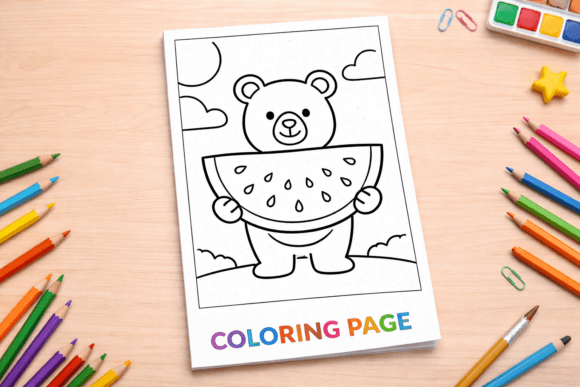
If you create content for kids—coloring books, classroom worksheets, or digital activity packs—you know the challenge. You need art that is clean, engaging, and production-ready. You do not have time to fix jagged lines, adjust low resolution, or worry about licensing grey areas. The Cute Bear Holding Watermelon Coloring bundle solves all of that with a single, well-crafted design asset. It is a black-and-white line art illustration featuring a friendly teddy bear holding a large slice of watermelon under an open sky. But more than that, it is a practical tool built for the real workflows of publishers, educators, and small shop owners.
The Design DNA: Bold Lines and Clear Intent
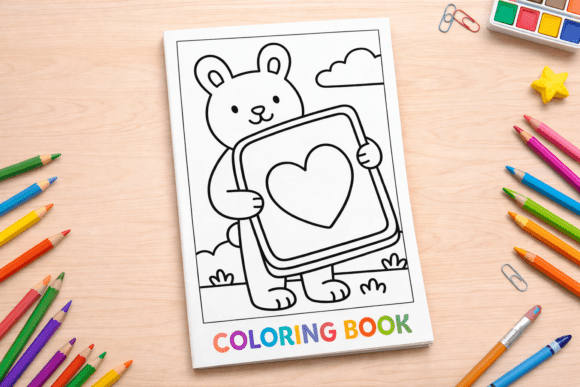
What makes this illustration stand out is not complexity—it is restraint. The outlines are bold and consistent. There are no unnecessary details that frustrate a toddler or complicate a print run. The bear is centered, the watermelon is large and recognizable, and the sky background gives context without overwhelming the main subject. For a child, this means a predictable, satisfying coloring experience. For you as a creator, it means the page works across multiple formats without losing its charm.
The personality here is warm and approachable. It fits naturally into summer themes, fruit lessons, or animal collections. Because the line weight is uniform, the page pairs well with other illustrations in a series. You can build an entire activity book around this visual language without jarring transitions. That consistency is what separates a professional product from a hobby project.
Where This Asset Belongs in Your Product Line
The real strength of the Cute Bear Holding Watermelon Coloring bundle is its versatility. I have seen similar assets used in four distinct ways, and each one works because the file package is complete.
KDP Interiors and Print-on-Demand Books
If you publish on Amazon KDP, you know that interior files must be perfect. The print-ready PDF included here is formatted at 8.5 by 11 inches with 300 DPI resolution. That means it passes Amazon’s upload requirements without extra tweaking. You can drop this page into a larger manuscript alongside other professional line art. Whether you are creating a standalone coloring book or a mixed activity book, this page holds its own. The JPG and PNG files are also useful for mockups and preview images on your listing.
Worksheets and Classroom Printables
Teachers and homeschoolers need materials that print clearly on standard office paper. The bold outlines in this design survive photocopying and laser printing. You can use the page as a Friday wind-down activity, a lesson supplement for a unit on healthy eating, or a free time station. The high resolution ensures that even if you scale the image down slightly to fit a smaller worksheet format, the lines stay sharp.
Etsy Digital Shops and Bundles
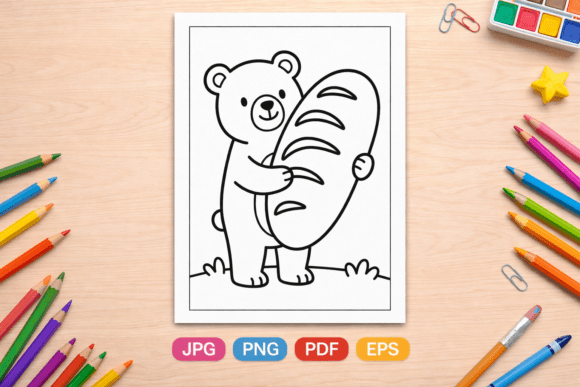
For Etsy sellers, the key is value. This single page works well inside a larger bundle of summer or fruit-themed coloring pages. The EPS vector file is a bonus here. If you want to resize the bear for a different project—a sticker sheet, a cover page, or a bookmark—the vector format gives you complete control. You can tweak the art without losing quality, which is not possible with a standard raster image.
Practical Workflow: Getting the Files Into Your Tools
Let’s talk about how this bundle actually fits into a typical creation process. I want you to feel confident opening these files and putting them to work immediately.
- Using the PNG or JPG: Perfect for drag-and-drop design platforms like Canva, Adobe Express, or even Google Slides. Use these for digital products or quick layouts. The transparent background of the PNG is particularly useful if you want to place the bear on a colored page without white boxes.
- Using the Print-Ready PDF: This is your best option for KDP interiors. Upload it directly as a single page or combine multiple PDFs using a tool like Adobe Acrobat. No margin adjustments needed if you stay within the 8.5 by 11 format.
- Using the EPS Vector File: Open this in Adobe Illustrator or a free alternative like Inkscape. Here you can change the line color, adjust the stroke weight, or rotate elements. Vector files are infinitely scalable, so you could blow this bear up to poster size without pixelation.
This workflow flexibility is why designers and publishers keep a library of vector-based line art. You are not locked into one use case. One purchase can serve a coloring book today and a sticker pack next month.
Commercial Licensing and Brand Building
The bundle includes commercial use rights. This is critical for anyone selling products. You can include this page in a paid coloring book, a teacher pay teacher resource, or a client project. Just remember the standard rule with design assets: you cannot resell the raw file as-is. It must be part of a larger, original product. This is standard practice, and it protects both the artist and the buyer.
From a brand identity perspective, using curated art like this builds recognition. When customers see your product, they may not know exactly what they like about it. They just know it looks professional. The even lines, the appropriate theme, and the print-ready resolution all contribute to a perception of quality. Over several products, this builds trust. Parents and teachers return to creators who consistently deliver a frustration-free experience for their kids.
Readability and Visual Hierarchy for Young Users
Coloring pages have their own form of readability. A child needs to look at the image and immediately understand what to do. The Cute Bear Holding Watermelon Coloring page succeeds here because the subject is obvious. The large central shape gives a natural starting point for coloring. The sky and watermelon provide secondary areas that reinforce the theme without cluttering the page.
For young children, fine motor skills are still developing. The bold outlines mean that going outside the lines is less frustrating. The large areas reduce the need for precise control. As a designer or publisher, thinking about this experience is essential. A coloring book that frustrates a child creates a bad association for the parent. Pages like this one, designed with the user’s ability in mind, generate better reviews and repeat purchases.
Real-World Example: Building a Summer Activity Book
Let me walk through a practical scenario. You are creating a forty-page summer activity book for preschool. You have tracing pages, counting exercises, and mazes. You want to include ten coloring pages to balance the educational content with fun. You source the Cute Bear Holding Watermelon Coloring page for the fruit section.
Because the line art is consistent with other well-made pages in your book, the overall aesthetic holds together. The parent flipping through the book on Amazon sees a cohesive product. The child reaches for the bear page first because it is friendly and familiar. You, the publisher, spend ten minutes assembling your PDF and uploading it. The entire transaction is efficient because the asset was built for exactly this purpose.
That is the value of a premium design asset. It is not just a picture. It is a solved problem. You pay for the convenience of not having to commission custom art, not having to clean up low-resolution files, and not having to worry about licensing terms.
Final Observations on Choosing Curated Design Assets
Creators who build successful shops and publishing catalogs do not use random clip art. They build libraries of trusted assets. They know which files print well, which themes sell, and which formats save them time. The Cute Bear Holding Watermelon Coloring bundle fits that strategy. It is a targeted asset for a perennial theme—summer, fruit, and friendly animals. It comes in the formats that professionals actually need. And it is designed with the end user, a young child, firmly in mind.
When you evaluate a design asset, ask yourself what it saves. Does it save you editing time? Does it save you worry about print quality? Does it save you from a licensing headache? If the answer is yes, it is worth adding to your toolkit. This bear passes that test.