2026 Post Planner for LinkedIn® Kdp Interior: A Flexible Tool for Organized Content Planning
Planning content consistently for LinkedIn presents a recurring challenge for many professionals. Between managing posting schedules, tracking campaign ideas, and maintaining a cohesive brand voice, the organizational overhead can become surprisingly time-consuming. The 2026 Post Planner for LinkedIn® Kdp Interior attempts to address this need by offering a structured yet customizable system for mapping out a full year of LinkedIn content. Rather than a rigid, one-size-fits-all template, this product provides a foundation that users can adapt to their specific workflow, making it worth a closer look for anyone serious about LinkedIn strategy.
What the 2026 Post Planner Offers
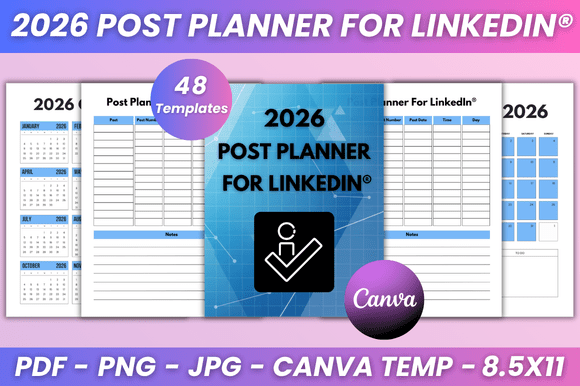
At its core, this planner is a 48-page, print-ready document designed to help users organize LinkedIn posts across 2026. It includes a complete monthly planner from January through December, along with dedicated pages for notes, important dates, and post-specific planning. The 2026 Post Planner for LinkedIn® Kdp Interior is delivered as editable Canva files, meaning every element—fonts, colors, layout, image placement—can be modified to match personal branding or aesthetic preferences. The package includes high-resolution PDF, JPG, and PNG files, all formatted at 8.5 x 11 inches with no bleed, which makes printing straightforward on standard office or home printers.
What distinguishes this planner from generic calendar templates is its focused design for LinkedIn content. Instead of a general daily planner, the structure encourages users to think in terms of posts, themes, and monthly content arcs. Each month provides space to outline key messages, schedule posts, and track what worked or what could be improved. This targeted approach saves users from having to retrofit a general planner into a LinkedIn content strategy tool.
Full Customization Without Design Skills
One of the most practical aspects of the 2026 Post Planner for LinkedIn® Kdp Interior is how accessible the editing process is. Because everything lives inside Canva, users don't need advanced graphic design software or technical expertise. Changing fonts, adjusting color palettes, resizing elements, or swapping in new images can be done in minutes. This is especially valuable for entrepreneurs, freelancers, and small business owners who may not have a dedicated design team but still want a polished, brand-consistent planner.
For example, a consultant who uses a specific brand color and font across their LinkedIn profile and website can replicate that look in the planner by simply updating the Canva template. This consistency reinforces brand recognition, even in internal planning documents. The editable Canva link also means the planner can be reused year after year by simply resetting the dates or duplicating the file.
Print and Digital Flexibility
The inclusion of multiple file formats—PDF, JPG, and PNG—adds meaningful flexibility. Users who prefer a physical notebook can print the PDF at home or at a local print shop. Those who work primarily on tablets or digital note-taking apps can import the JPG or PNG files into applications like GoodNotes, Notability, or OneNote and write directly on the pages. This dual functionality means the 2026 Post Planner for LinkedIn® Kdp Interior fits into different workflows without forcing a specific medium. A digital-first creator might keep the planner on an iPad and annotate with an Apple Pencil, while a more traditional professional might print it and keep it in a binder on their desk. Both approaches work seamlessly.
Clean, Minimal Design
The design philosophy here is intentionally minimal. There are no distracting graphics, busy borders, or overwhelming color schemes. This is a strength, not a limitation. A clean layout reduces visual noise and helps users focus on the content planning itself. The minimalist approach also makes the planner more adaptable to different branding styles. A user with a bold, vibrant brand can easily add color and imagery, while someone who prefers a neutral, professional look can leave the design as is. The 2026 Post Planner for LinkedIn® Kdp Interior serves as a neutral canvas that works with many aesthetics rather than imposing its own.
Usability and Real-World Application
In practical use, the planner encourages a monthly content review cycle. Each month's spread includes space for post topics, key dates or events, and notes on performance or ideas for improvement. This structure naturally supports the kind of reflective planning that leads to better LinkedIn engagement over time. Instead of posting reactively day by day, users can map out themes, align posts with product launches or industry events, and ensure a balanced mix of content types—educational, promotional, personal, and community-building.
A realistic example might be a marketing professional planning for Q1 2026. They could use the January page to outline posts about industry trends, the February page to prepare for a conference they're attending, and the March page to highlight a new service offering. Having this visibility months in advance reduces last-minute scrambling and allows for higher-quality content production. The 2026 Post Planner for LinkedIn® Kdp Interior makes this kind of forward-looking planning straightforward because the monthly structure is already built in.
One understated feature is the inclusion of a "Belongs To" page and a "Thank You" page. While small, these touches add a sense of ownership and professionalism. If the planner is printed and used in a team setting, the Belongs To page can assign it to a specific person or role. The Thank You and notes pages also provide space for documenting lessons learned or recording successful post formats worth repeating.
Who Benefits Most from This Planner
Based on its design and feature set, the 2026 Post Planner for LinkedIn® Kdp Interior is best suited for a specific range of users:
- Independent professionals and freelancers who need a lightweight, customizable system for managing their own LinkedIn presence without the overhead of a full content management tool.
- Small business owners and entrepreneurs who wear multiple hats and benefit from a visual, print-friendly planner that can be reviewed quickly during busy weeks.
- Content creators and bloggers who publish regularly on LinkedIn and want to track topic clusters, series, or recurring post formats across the year.
- Educators and coaches who use LinkedIn to share expertise and want to plan educational content in advance, aligning posts with course launches or events.
- Publishers and KDP interior designers who appreciate the clean, editable format and may use it as a product offering themselves or as a personal organizational tool.
The planner is less ideal for large marketing teams with complex approval workflows or for users who need advanced analytics integration. It is intentionally a planning tool, not an analytics dashboard. For those who primarily need a structured way to brainstorm, schedule, and review LinkedIn content individually or in a small team, however, it provides a straightforward solution.
Quality, Presentation, and Long-Term Value
The production quality of the 2026 Post Planner for LinkedIn® Kdp Interior meets a professional standard. The PDF files are print-ready at 300 DPI, which ensures sharp text and clean lines on paper. The absence of bleed simplifies printing—users don't have to worry about content being cut off or needing to trim edges. The PNG and JPG files are also high resolution, so digital use remains crisp on modern screens.
From a long-term value perspective, the editable Canva link means this planner is not a one-time-use product. Users can duplicate the template each year, adjust the dates, and continue using the same structure. This makes the cost per year of use quite low, especially for someone who plans to maintain a LinkedIn presence for several years. The instant download and lifetime access further remove friction from the purchasing process.
One aspect worth noting is the disclaimer included with the product: the 2026 Post Planner for LinkedIn® Kdp Interior is independent and not affiliated with, sponsored by, or endorsed by LinkedIn Corporation. This is a straightforward and honest positioning that should reassure users that the product is a third-party tool designed to complement LinkedIn, not a licensed or official LinkedIn product. The planner stands on its own merits as a content organization resource.
Practical Limitations to Consider
No tool is perfect for every situation, and this planner has a few limitations worth considering. First, it is focused on monthly and post-level planning but does not include a weekly or daily breakdown. Users who prefer granular day-by-day scheduling may need to supplement this planner with a separate daily agenda or digital calendar. Second, the planner does not include built-in space for tracking engagement metrics or analytics. Users should plan to keep separate records of post performance or use LinkedIn's native analytics alongside the planner.
Also, because the product is designed as a 2026 Post Planner for LinkedIn® Kdp Interior, it is year-specific in its current form. While the Canva template can be adapted for other years, users who want a ready-to-use 2027 planner would need to update the dates manually. This is a minor inconvenience but worth noting for those who prefer completely turnkey solutions.
Final Thoughts on the 2026 Post Planner for LinkedIn® Kdp Interior
The 2026 Post Planner for LinkedIn® Kdp Interior fills a specific niche well. It offers a clean, minimal, fully editable structure for organizing LinkedIn content across an entire year, and it does so in a way that respects the user's time and design preferences. The flexibility of print and digital formats, the ease of customization through Canva, and the practical monthly layout make it a useful resource for professionals who want to plan their LinkedIn presence with intention rather than spontaneity.
For someone who already understands the value of content planning but lacks a structured system, or for someone who wants to move from ad-hoc posting to a more organized approach, this planner provides a solid starting point. It is not a flashy, overengineered product—it is a functional tool built around a clear purpose. And in the realm of content planning, that clarity is often exactly what makes the difference between a good idea and consistent execution.