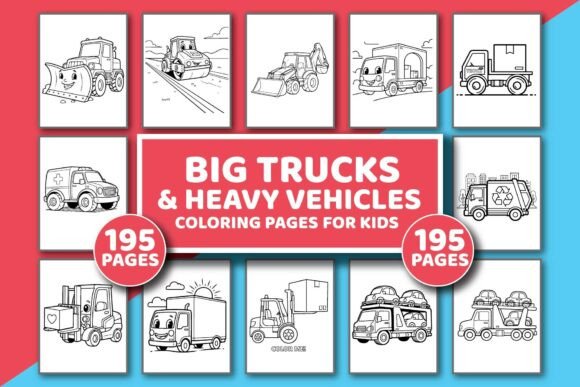
Big Trucks Heavy Vehicles Coloring Art – A Practical Resource for Creators and Enthusiasts
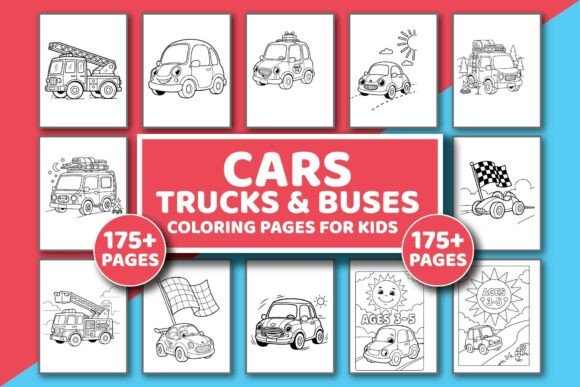
The Big Trucks Heavy Vehicles Coloring Art collection brings together 195 pages of detailed illustrations featuring semi trucks, monster trucks, dump trucks, cement mixers, bulldozers, excavators, cranes, fire trucks, tow trucks, and many more heavy vehicles. This is not just a coloring book for children. It is a versatile asset that fits into publishing workflows, creative projects, educational materials, and commercial use. Understanding what this collection offers and how to integrate it into your process can save time, improve output quality, and open up new opportunities.
Whether you are a self-publisher preparing a KDP interior, a teacher assembling activity sheets, or a hobbyist looking for a structured way to unwind, this collection provides a ready-to-use foundation. The files come in JPG, PNG, SVG, PDF, and AI formats at 300 DPI, so you are prepared for print or digital distribution from the start. This article walks through the practical ways you can use the Big Trucks Heavy Vehicles Coloring Book – 195 Pages in your own work or routine, with attention to preparation, compatibility, organization, and long-term value.
What the Collection Covers and Why It Matters
The core of this resource is variety and detail. With 195 pages of heavy vehicle illustrations, you get a wide range of machinery types, each rendered with enough complexity to engage different skill levels. Semi trucks feature long hauls with multiple trailer configurations. Construction machines like bulldozers and excavators show treads, arms, and cab details. Emergency vehicles such as fire trucks and tow trucks include ladders, hoses, and towing mechanisms. This variety means the collection works for young children just learning to color within lines, as well as adults who prefer more intricate designs for stress relief.
From a process perspective, having all these illustrations in one place eliminates the need to source individual images, negotiate licenses, or worry about resolution issues. The inclusion of vector formats (SVG and AI) also means you can resize, recolor, or combine elements without losing quality. This makes the collection suitable for both print-on-demand projects and digital products where flexibility matters.
The practical value becomes clear when you map the collection to real-world use cases. Whether you are creating a physical coloring book, a digital download for a content platform, or a set of classroom handouts, the 300 DPI files ensure crisp lines and professional results. For commercial projects, the included license covers standard uses, so you can proceed without additional legal overhead.
Integrating the Collection into Publishing and Content Creation Workflows
For self-publishers using platforms like Amazon KDP, the Big Trucks Heavy Vehicles Coloring Art collection streamlines several stages of production. Instead of drawing or commissioning illustrations, you receive print-ready files that only need to be arranged into a book layout. The PDF format works well for direct import into layout software such as Adobe InDesign, Canva, or Affinity Publisher. You can add page numbers, include a table of contents, or insert single-sided pages to prevent bleed-through issues.
If you are creating a digital product—such as a downloadable PDF for Etsy or Gumroad—the PNG and JPG formats allow you to offer previews, sample pages, or separate the images into themed bundles. For example, you could group construction vehicles together for one product and emergency vehicles for another. The SVG and AI files give you the ability to customize illustrations, perhaps by simplifying a design for younger children or adding your own branding elements. This modular approach means you can create multiple products from a single collection, increasing your output without additional design work.
Quality control is straightforward. Because all files share the same resolution and format standards, you avoid mixed-resolution issues that can cause printing problems. Before committing to a final layout, print a test page to confirm line thickness and paper compatibility. If you plan to sell through a print-on-demand service, check their trim and bleed requirements early. The 300 DPI files are designed for print, but you can down-sample them for digital use when file size matters.
Practical Tips for Publishers and Designers
- Check your import settings: When placing AI or SVG files into layout software, verify that scaling is set to 100% to preserve the original resolution.
- Use layers wisely: If you edit SVG files in vector software, keep the outline and fill on separate layers. This makes it easy to experiment with color variations or create grayscale versions.
- Test with your printer: Different printers handle line art differently. Run a proof print to ensure thin lines are not lost and thick lines do not create blur.
- Bundle strategically: Group pages by vehicle type (construction, emergency, transport) to create smaller, niche coloring books that target specific interests.
- Respect the file structure: Keep the original files organized in folders by format. This helps when you need to replace or regenerate a file later.
Using the Collection in Educational and Therapeutic Settings
Educators and therapists often need materials that combine structure with creative expression. The Big Trucks Heavy Vehicles Coloring Book – 195 Pages provides exactly that. For teachers, the illustrations can supplement lessons about transportation, community helpers, or construction. You can print individual pages for a unit on heavy machinery or use the full set as a reward activity. The clear, accurate depictions of vehicles also support vocabulary development—students can learn the names of parts like boom, cab, tread, and axle while coloring.
For occupational therapists or counselors, coloring offers fine motor skill practice and a calming activity. The variety of detail levels allows you to match pages to a client’s current abilities. A child who struggles with small spaces can start with larger, simpler vehicle outlines. As skills improve, they can move to pages with more intricate tread patterns or multiple vehicle components. The digital formats also make it easy to enlarge or reduce pages without distortion, giving you control over the complexity.
In a classroom workflow, preparation is key. Print a selection of pages in advance and organize them by difficulty or theme. Laminate frequently used pages for reuse with dry-erase markers. If you are distributing digitally through a learning management system, convert the PNG files to PDFs with secure permissions to prevent unauthorized editing. The SVG files can be imported into interactive whiteboard software, allowing students to color vehicles digitally as a group activity.
Implementation Ideas for Educators and Therapists
- Theme your sessions: Plan a week around construction vehicles, then switch to emergency vehicles. Use the coloring pages as visual anchors for discussion.
- Combine with writing prompts: After coloring, have students write a short story about where the vehicle is going or what it is carrying.
- Use for reward systems: Let students choose a page to color after completing other tasks. The variety keeps the reward fresh.
- Create take-home kits: Bundle a few printed pages with crayons in a zip pouch for families to use at home.
Leveraging the Collection for Personal Enjoyment and Stress Relief
For adults who color as a relaxation practice, the Big Trucks Heavy Vehicles Coloring Art collection offers a focused, repetitive task that can quiet a busy mind. The detailed illustrations require attention, which naturally shifts focus away from daily stressors. Unlike abstract designs, these pages have recognizable subjects that can feel more grounding. You might choose a cement mixer one day and a crane the next, working through the different mechanical elements at your own pace.
From a workflow perspective, having a dedicated routine helps. Set aside a specific time—perhaps 15 minutes in the evening—and prepare your materials in advance. Print a set of pages you find appealing, and choose your coloring tools. Colored pencils work well for the fine details, while markers can cover larger areas quickly. The 300 DPI print files mean your materials will look crisp regardless of the paper you use, though heavier paper prevents bleed for marker users.
Organization matters for long-term use. Keep the digital files on a cloud drive so you can access them from any device. Create a folder structure by vehicle type or complexity. When you finish a page, take a photo or scan it before storing it. This builds a personal gallery of your work and lets you track progress over time. If you share your finished pages on social media, the high-resolution source files mean you can export clean images for posting.
Commercial Use and Product Development
Entrepreneurs and small business owners can use the Big Trucks Heavy Vehicles Coloring Book – 195 Pages as a foundation for multiple revenue streams. The included commercial license covers standard print-on-demand products, digital downloads, and physical copies. You can create a softcover coloring book through KDP, offer a digital bundle on your own website, or even use individual pages as bonus content in a larger product.
When developing products, consistency matters. All 195 pages share a similar illustration style, so any subset you choose will feel cohesive. This is an advantage over mixing resources from different sources. For a truck-themed gift set, combine printed pages with a small pack of colored pencils and a custom cover you design in Canva. The AI files let you modify the original illustrations to create a cover that matches your brand colors.
Long-term maintenance is minimal. Store the master files in a secure location with a clear naming convention. If you update your product listing, you can pull new sample pages from the collection without recreating anything. Because the files are high resolution, they remain viable for years without degradation. This is especially important for digital products where customers expect clean, scalable assets.
Commercial Workflow Checklist
- License confirmation: Verify the terms of your commercial license for print-on-demand and digital sales.
- Cover design: Use the AI or SVG files to create a cover that features your favorite truck illustrations.
- File preparation: Convert PDF pages to the trim size required by your printer. Add margins and bleeds.
- Test print: Order a single proof copy to check color, alignment, and paper quality before launching.
- Product listing: Upload sample images from the collection as previews. Use the included formats to create mockups.
Preparing for Long-Term Use
Whether you are building a library of resources for repeated classroom use or planning a series of coloring books, the Big Trucks Heavy Vehicles Coloring Book – 195 Pages supports ongoing projects. The digital formats allow you to archive the files without physical storage concerns. Over time, you can revisit the collection for new ideas: combine vehicle types, create seasonal themes, or use the AI files to develop activity sheets that include tracing or matching exercises.
For maximum efficiency, organize the files early. Create a master folder with subfolders for each format. Inside the PDF folder, separate the file into groups if you plan to use only certain pages. Label each file descriptively, such as “semi-truck-01” or “excavator-detailed,” so you can find specific illustrations quickly. This upfront organization saves hours when you are on a deadline.
Consistency in your use of the collection also improves outcomes. If you are a publisher, stick with one format (like AI or PDF) for your layout work to avoid confusion. If you are an educator, decide in advance whether you will print in black and white or colorize some pages for display. Having a clear process helps the collection become a reliable part of your toolkit rather than a one-time download.
Final Observations on Integration
The Big Trucks Heavy Vehicles Coloring Book – 195 Pages is more than a single product. It is a resource that adapts to different workflows—publishing, education, personal relaxation, and commercial product development. The variety of vehicles, the inclusion of multiple file formats, and the high resolution make it a practical choice for anyone who needs a large set of truck and heavy vehicle illustrations. By treating the collection as a modular asset, you can extract value for years, whether you are printing one page for a quiet evening or producing a full-color book for a global audience.
The shift from seeing this as a simple coloring book to understanding it as a workflow component is what separates a casual user from someone who gets consistent results. Take time to explore the files, test them in your software, and decide how they fit into your larger goals. That preparation pays off every time you open the collection for a new project.